Permits
Where Can a Dumpster Actually Go in Altoona?
On your own driveway, almost always fine. The complication here is not permits — it is working out which municipality you are actually in.
The short answer
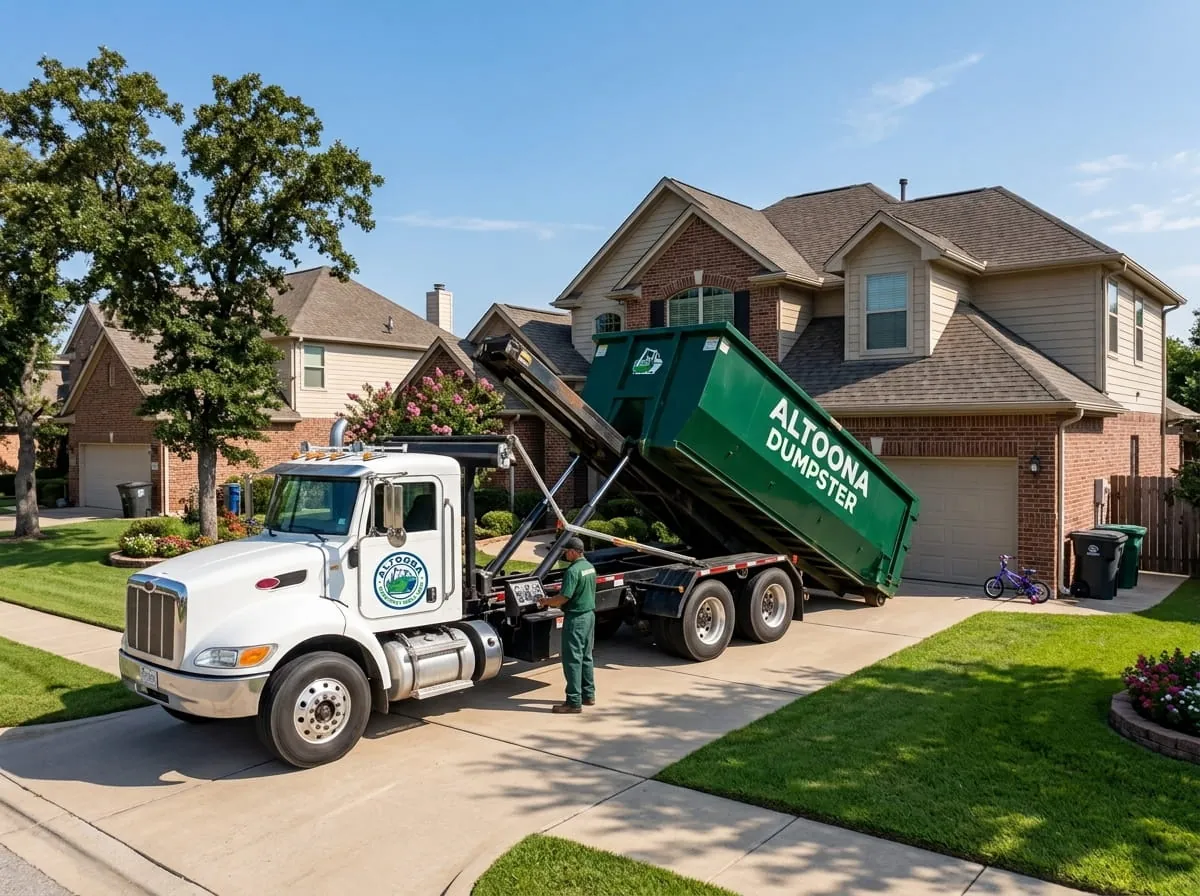
If a temporary roll-off is going on your own driveway for the duration of a project, you are almost certainly fine without a placement permit. That covers the large majority of what we deliver.
If it has to sit on a public street, you need permission from whichever municipality the address is actually in — and around Altoona, working out which one that is takes more care than usual.
Private property: a temporary roll-off
A driveway, a private parking area, a fenced construction site, a farmyard or a commercial lot you own or lease is private property, and a temporary container placed there for a project is not the thing municipal dumpster rules are aimed at.
Two caveats that are not placement permits but behave like them:
- The underlying work may need a building permit. Structural, electrical, plumbing, roofing and anything touching the building envelope generally do.
- If the property is a rental or has an association, their permission is not optional.
One local point worth knowing: Altoona's ordinance makes it unlawful to place or permit to remain municipal waste, refuse or recyclables anywhere in the City — including on private property — except yard waste composted acceptably. A container being loaded during a project is not what that clause is aimed at, but a pile of debris accumulating on your lot for months genuinely could be. If a job is going to run long, a container is the tidier answer as well as the easier one.
Public street: right-of-way permission
Placing a container in the roadway means occupying public right-of-way, and every municipality here regulates it in some form. The reasons are consistent: emergency access, sight lines, drainage and night-time visibility — plus, in this climate, snow clearance.
Our advice is always to get it onto private property where possible. On the flatter valley ground and the more open township properties that is usually easy. In the older borough streets — Bellwood, parts of Tyrone, Hollidaysburg near the courthouse, Roaring Spring — it is sometimes genuinely not.
Useful numbers for judging your own frontage: a 20 yard is twenty-two feet of container and the truck needs roughly ten more feet of clear run behind it. A 15 yard takes six feet less on the ground.
There is a second reason to avoid the street here that people underestimate: this is snow country. A container in the roadway through a winter storm is in the way of a plough, and on a graded street it is in the way of something with momentum.
⚠️ Which municipality are you in?
The genuine complication in our service area, and it matters more than the permit question itself.
Logan Township wraps around much of the city. It is a separate municipality with its own governing body — but it is one of the three IRC members alongside Altoona and Hollidaysburg, so recycling and composting requirements broadly track the city's. The distinction matters for right-of-way permission and for anything the township regulates directly.
Beyond those three, everything is separate again:
- Boroughs — Duncansville, Bellwood, Tyrone, Roaring Spring, Martinsburg, Williamsburg, Newry — each set their own rules and none are IRC members.
- Townships — Antis, Frankstown, Allegheny, Blair, Freedom, Greenfield — are governed by township supervisors rather than a borough council.
- Communities like Claysburg and East Freedom are not boroughs at all; they sit within townships, so municipal questions go to the township.
- Huntingdon is in a different county entirely.
We confirm the municipality on every booking, and if street placement turns out to be necessary we will tell you which office to approach.
Collection zones, days and hours
Worth knowing because it shapes what any operator here can offer.
Altoona's solid waste ordinance sets collection days and hours, and establishes collection zones and no-collection days. Those are set by the City rather than by preference, which is why "can you come Sunday" sometimes gets a straight no from any local operator.
The ordinance also restricts transferring waste between collection vehicles within the City — permitted only at an approved transfer station, or where terrain or weather prevents a vehicle reaching the waste. That second clause is the one that tells you most about what delivering on this ground is like.
The other permits that actually matter
The container is rarely the regulated thing. These are:
- Building permits for the underlying work, from your own municipality
- Demolition permits, usually separate, and often carrying asbestos conditions
- Asbestos survey requirements before demolition on older buildings — with this much pre-1980 housing and this many older farm buildings, it comes up constantly
- Utility locates. Call 811 before any excavation — free, required, not optional
- Pennsylvania's waste framework, which requires municipal waste to go to facilities permitted by the Commonwealth. It rarely touches a homeowner directly, but it is why your hauler should be able to tell you exactly where your material goes
Access, canopy and grade
Three practical constraints that stop more deliveries here than permits do.
Grade. The big one locally, and the City's own ordinance acknowledges it. A sloped or gravel driveway changes what a loaded truck can safely do — covered in full here.
Overhead branches. Our truck needs roughly twenty-two feet of clear height to raise its bed. The mature canopy across this area is genuinely low in places, and on a job with a mid-course swap it has to work twice.
Winter. Snow banks narrow a driveway by a foot on each side, ice on a grade changes everything, and a container frozen into place is a real problem at collection. If your project runs through January or February, tell us — including where the snow gets pushed.
What we need from you
- Whether the container is going on private property or the street
- The full address, so we can confirm which municipality you are in
- Whether there is a landlord or association, and whether you have asked them
- Your driveway length, width, surface and grade
- Any branches, wires or low overhang near the placement
- Whether the underlying work is permitted
- In winter, where the snow has been pushed
We cannot pull right-of-way permission for you — it attaches to the property owner or contractor — but we work across all of these municipalities and can make sure you ask the right one first time.
Ordinances vary by municipality and change over time. Everything above reflects how these jurisdictions generally operate at the time of writing, and the Altoona-specific points apply to the City of Altoona only. For anything consequential, confirm with your own municipal office — and check first which one that actually is.
Need a container in Altoona?
Call and describe the job. Three minutes on the phone gets you a size recommendation, a flat rate and a delivery window — and we will tell you if a smaller, cheaper container is the right answer.
Call (582) 558-8207